
What is the MEMS sensor?

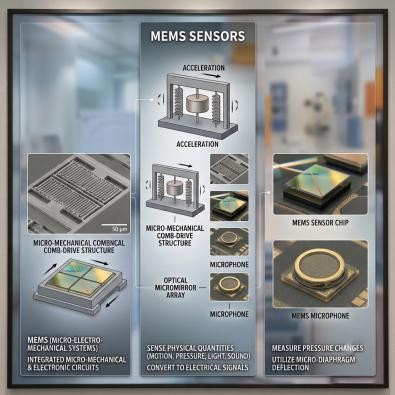
A MEMS sensor is a type of device fabricated using MEMS technology, with its primary function being to convert various physical or chemical quantities from the natural world—such as pressure, acceleration, angular rate, magnetic field, temperature, sound, gas concentration, etc.—into electrical signals that can be read and processed by electronic systems.
The operating principle of a MEMS sensor can be summarized in three steps:
Sensing: An external physical quantity acts upon the sensitive mechanical structures within the MEMS (e.g., proof mass, diaphragm, cantilever), causing them to deform or displace.
Transduction: Through a physical effect (such as piezoresistive effect, capacitive change, or piezoelectric effect), the mechanical deformation is converted into a change in an electrical parameter (resistance, capacitance, voltage, frequency, etc.).
Output: On-chip or external electronic circuits amplify, calibrate, and convert these electrical parameter changes into standardized signals (e.g., analog voltage or digital outputs like I²C/SPI) for use by processors.
Common types of MEMS sensors include accelerometers, gyroscopes, pressure sensors, microphones, magnetometers, temperature sensors, and gas sensors. Thanks to their small size, low power consumption, fast response, high accuracy, excellent reliability, and suitability for mass production, they have become core sensing components in smartphones, wearables, automotive electronics, industrial IoT, and healthcare applications.