翻訳を編集
MEMS Differential Pressure Sensors for HVAC Applications

The Critical Role of Differential Pressure Sensors in Building Automation
In modern building automation systems, MEMS differential pressure sensors are core sensing components that enable HVAC systems to operate efficiently, safely, and with optimal energy performance. As urban building density increases and environmental regulations become more stringent, facility managers face the dual challenge of precisely controlling indoor environments while minimizing energy consumption. Differential pressure sensors provide essential feedback to building automation systems by monitoring pressure differences between two points, enabling intelligent control strategies.
Key Application Scenarios
- Air Filter Monitoring
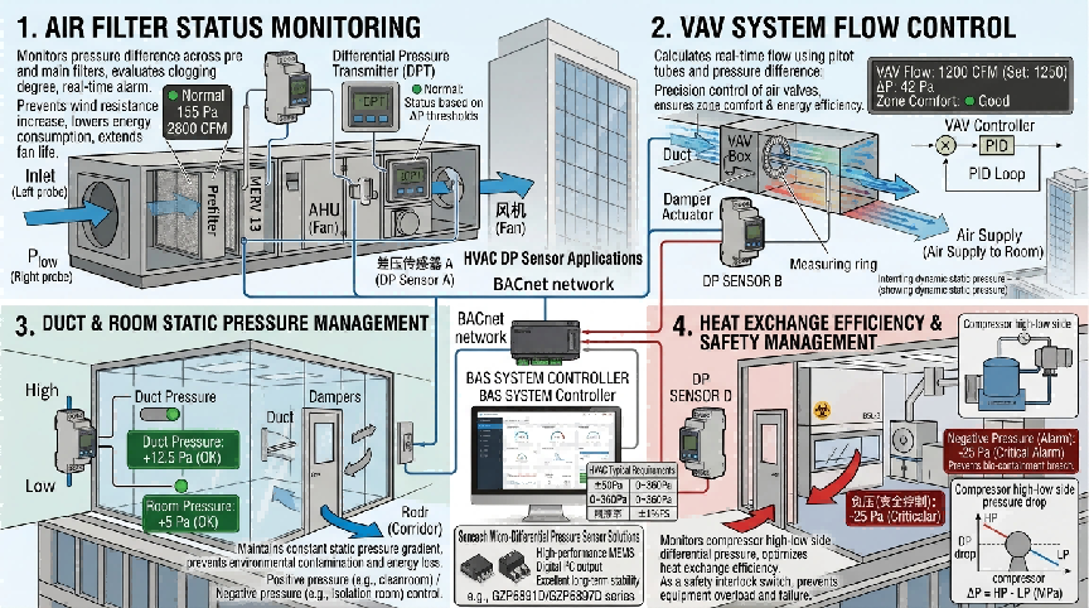
Air filters are critical components in any HVAC system, directly impacting indoor air quality and system energy efficiency. By installing a differential pressure sensor across the filter to measure the pressure drop on both sides, the building automation system can continuously monitor airflow conditions. As the filter becomes clogged, airflow resistance increases, and the pressure differential rises accordingly. When the differential pressure reaches a preset threshold, the sensor signal triggers an alert, prompting maintenance staff to replace or clean the filter. This proactive approach prevents increased fan energy consumption and excessive wear on other system components caused by high airflow resistance.
- Variable Air Volume (VAV) System Flow Control
Variable Air Volume systems are the industry standard for distributing conditioned air in commercial buildings. In VAV systems, differential pressure sensors precisely measure airflow and pressure within air ducts, typically at very low pressures down to a few millibars (a few inches of water column). The sensor sends the detected differential pressure signal to the controller, which then adjusts damper positions to precisely control the volume of air delivered to each zone. This ensures occupant comfort while avoiding unnecessary energy waste. Sensors used in this application typically need to measure micro-pressures in the range of ±50 Pa.
- Duct Pressure and Room Static Pressure Management
Differential pressure sensors are also used to monitor the relative pressure difference between air ducts and room air. Negative room pressure can allow unfiltered outdoor air to infiltrate through gaps around doors and windows, compromising indoor air quality and thermal comfort. Conversely, excessive positive pressure can make doors difficult to open or close and lead to loss of conditioned air. By measuring the differential pressure between ducts and rooms, the building automation system can automatically adjust outdoor air or exhaust dampers to maintain proper pressure gradients, enhancing indoor environmental quality and reducing energy costs.
- Heat Exchange Efficiency Optimization
In heating and cooling systems, the pressure differential across the compressor is a key indicator of heat exchange efficiency. Differential pressure sensors monitor the pressure difference between the high-side and low-side of the compressor in real-time, ensuring the system operates at peak performance. さらに, long-term monitoring of room static pressure can help identify issues such as degraded door or window seals, enabling early warnings to prevent energy losses.
- Safety Interlocks and Equipment Protection
Differential pressure sensors can also function as safety control elements, acting as pressure switches within the system. When the detected differential pressure exceeds or falls below safety setpoints, the system can automatically execute actions such as shutdown, opening pressure relief valves, or generating alarms, preventing equipment damage and ensuring operational safety.
Technical Selection Considerations
Parameter | Typical Requirements | ノート |
圧力範囲 | ±500 Pa (air duct); | Requirements vary significantly by application |
正確さ | ±1% FS or better | Directly impacts overall control system performance |
Media Compatibility | Clean air, non-corrosive gases | Harsh environments require corrosion-resistant models |
Temperature Compensation | -10°C to 60°C | Ensures stable operation across the full temperature range |
出力信号 | アナログ (0.5-4.5Ⅴ) or Digital (I²C/RS485) | Choose based on control ystem interface |
Sencoch Differential Pressure Sensor Solutions
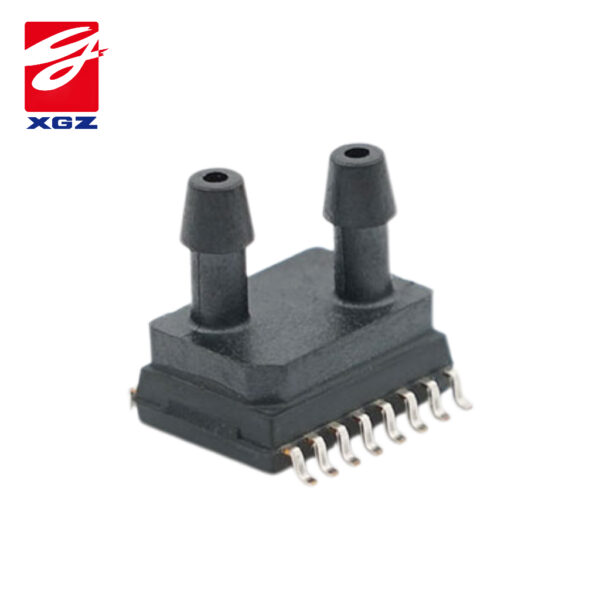
Sencoch offers high-performance MEMS differential pressure sensors specifically designed for HVAC system applications, with our flagship GZP6891(Analog or I2C for option) and GZP6897 (Analog or I2C for option) series.
Both sensor series supports a wide pressure range of ±500Pa to ±100 kPa in a SOIC dual-port package. It features analog voltage output or I²C digital output, built-in temperature compensation, and ultra-low standby current consumption (100 なし), making it well-suited for VAV system duct flow monitoring and cleanroom pressure control.
Built on proven MEMS piezoresistive technology, Sencoch sensors deliver high linearity, excellent long-term stability, and superior repeatability. The dual-port design enables true differential pressure referencing, minimizing measurement errors caused by variations in ambient pressure. They are an ideal choice for achieving efficient, 信頼性のある, and energy-saving control in building automation systems.